Sunday, January 13, 2013
East Earth Travelogues: A Visit to Ip Man's Grave
Tuesday, January 1, 2013
Actions of the Herbs found in Tung Shueh pills
Rhizoma Curcuma or Turmeric is an anti-inflammatory and is especially helpful for painful shoulders.
Rhizoma Homalomenae: The Chinese name is Qian Nian Jian or "thousand years of health." It is an important herb for treating joint pain that moves in the body or pain that is affected by changes in the weather. Chinese herbalists say that it strengthens the tendons and bones. It has a strong tonifying action and is also used for pain and swelling due to traumatic injuries. In China it is widely used for treating the elderly. It is traditionally combined with Achyranthis.
Fructus Chaemomelis Lagenariae is one of the more effective herbs for relaxing the tendons. It is beneficial for joint pain due to changes in weather and for pain in the lower extremities.
Fructus Psoraleae is helpful for painful or weak lower back and extremities.
Plastrum Testudinis or turtle shell strengthens the bones and is said to be good for weakness of the lower back and knees. It is composed of calcium, collagen (a protein found in connective tissue), lipids, amino acids, and phosphorus.
Angelicae Sinensis is one of the most researched herbs in Chinese medicine. It is traditionally used as a blood tonic but another important action is improving blood circulation and relieving pain. It is used for numbness and pain in the extremities and painful joints. Modern research has shown that it has analgesic and anti-inflammatory properties.
Cortex Cinnamomi is said to disperse cold in the body and alleviate pain. It is used for joint pain caused by wet and cold weather changes and back pain.
Frankicense promotes the circulation of energy in the body. It alleviates pain and is used for joint pain that moves in the body and pain that is affected by damp weather. Commonly used with Myrrha for chronic pain (caused by blood stagnation).
Myrrha circulates the blood and alleviates joint pain. It is commonly used with Frankincense for treating musculoskeletal pain.
Radix Aucklandiae is used to relieve stagnation.
Semen Benincasae is useful for circulating fluids in the body. In Chinese medicine fluid stagnation creates joint pain that feels heavy, distended or swollen.
Radix Morindae is useful for back, leg, and joint pain, as well as, muscle spasms and cramps.
Cortex Eucommiae is good for low back pain. it is also combined with Dipsaci for fractured or broken bones to promote the healing of bones.
Rhizoma Corydalis is one of the most commonly used and the most effective herbs used to relieve pain because it has an excellent ability to activate the Qi and Blood circulation in the body. Corydalis can treat pain in the upper and lower extremities and also be used for traumatic injuries. Research has shown it has analgesic and anti-inflammatory properties.
Radix Dipsaci is known in Chinese as Xu Duan or "restore what is broken." It is good for sore and painful lower back and knees, stiffness in the joints and weakness in the legs. It is said to promote the growth of bones when used for fractures.
Radix Achyranthis Bidentatae is good for the tendons, bones, and joints. It is often used with Eucommiae for pain and weakness of the lower back and extremities. It is commonly used for sports injuries.
Flos Carthami (safflower) alleviates pain. It is used to disperse blood stagnation and open the channels.
Tung Shueh can beordered at http://www.eastearthtrade.com/tungshuehpills.aspx
Monday, December 24, 2012
Translating Chinese
Mo Yan, the 2012 Nobel Prize winner for literature recently addressed a reception at the Chinese Embassy in Stockholm on December 7 during his tour to the Swedish capital to receive his prize. He said "I think translation is much harder than writing: It only took me 42 days to write Life and Death Are Wearing Me Out, while it took Swedish sinologist Anna Gustafsson Chen six years to translate the work." (Source: Beijing Review, December 20, 2012).
* see: http://theriverlands.blogspot.com/2010/02/translating-acupuncture-texts.html
Sunday, December 23, 2012
Chinese Idioms, English Idioms
It is: 活到老学到老 (huo2 dao4 lao3, xue2 dao4 lao3*) "One is never too old to learn".
It is much more positive and very true. We should continue to learn new things throughout our lives.
*The numbers after the words refer to tone marks
Wednesday, December 19, 2012
Hsing-I Training
Sunday, September 23, 2012
East Earth Travelogue: Shhh! "Grass is napping, please don't disturb"
This sign was posted on the front of a hotel in Baoding
Two signs from Xiang ge li la (Shangri-la) in Tibetan, Chinese and English.
Signs found around Lijiang
The sign below is from Lijiang. The top characters are in the Naxi Minority language, center is Chinese characters, and English below.
This was taken in the mountains around Jiuhua Shan. It has Chinese, English, and Korean. The picture says it all.
Saturday, September 15, 2012
East Earth Travelogue: Unusual Menu Offerings
You can click on the picture to enlarge and read.
Monday, September 10, 2012
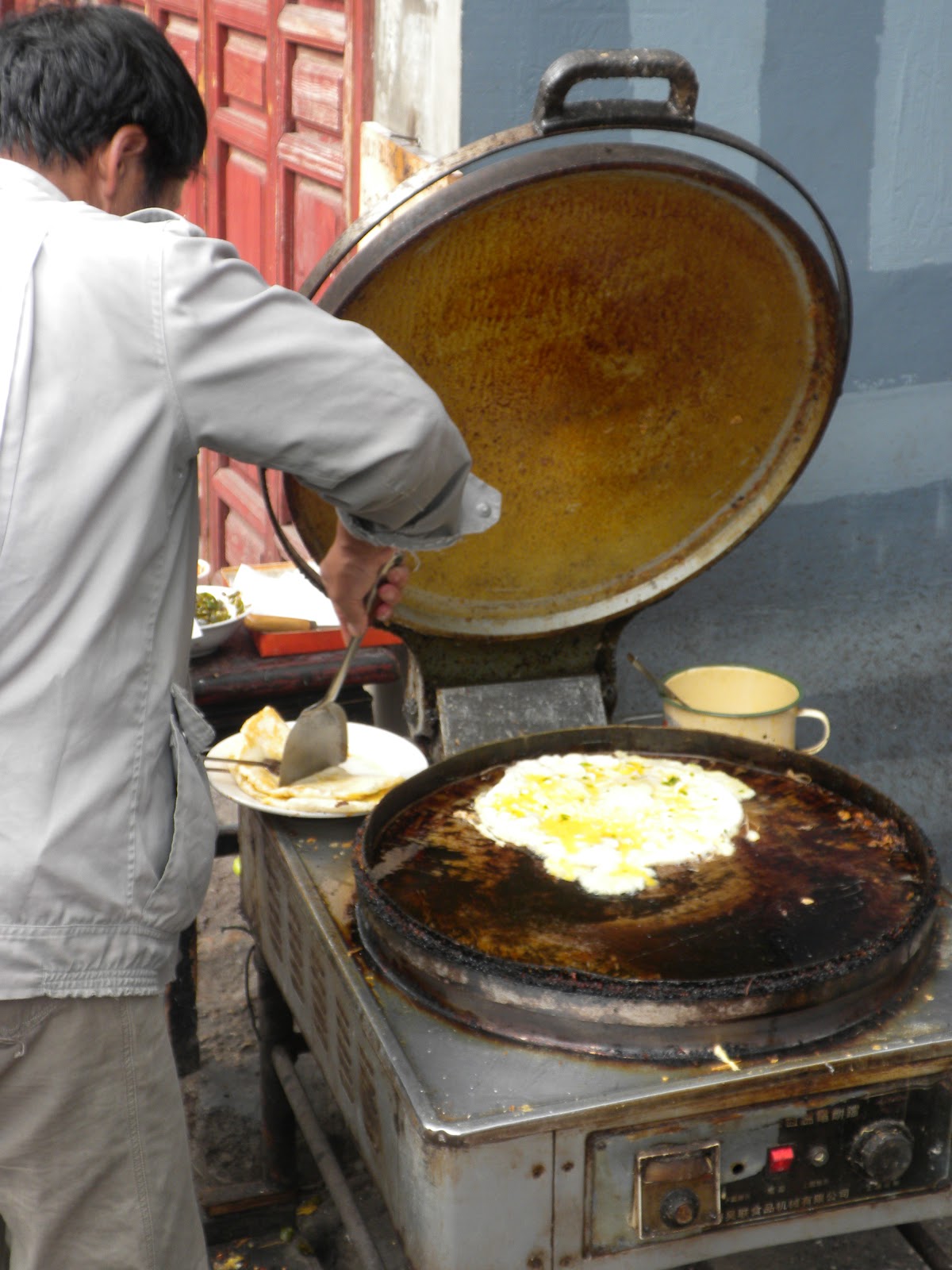
East Earth Travelogue: Delicious and Interesting Food
Saturday, September 8, 2012
East Earth Travelogue: Naxi Dancers, Lijiang, China
The colorful traditional dress of the Naxi women pictured below.
Monday, September 3, 2012
East Earth Travelogue: Ganden Sumtseling Monastery
View from the Monastery of the surrounding countryside.
Wednesday, August 29, 2012
China's Taoism Shrine to mark 600th anniversary
For the rest of the article, see:
http://english.peopledaily.com.cn/90782/7927318.html
Sunday, August 26, 2012
East Earth Travelogue: Xiang Ge Li La (Shangri-la) Watch Dog
Saturday, August 25, 2012
East Earth Travelogue: WuDang Kung Fu
Wudang Kung Fu (or Wudang Gong Fu) has its home at Wudang Mountain. Wudang Mountain is the birthplace of internal martial arts where the great Daoist priest Zhang San Feng came to live as a hermit and learn the Daoist methods of attaining immortality. During his time here and through his practice Zhang San Feng created Nei Jia Quan, or what is now more commonly referred to as Tai Ji (tai chi).
The main focus of the video is the performers in the center but you should watch the video a few times. If you do you'll notice in the back on a narrow stage is another martial artist who appears to be doing a separate form yet it blends seamlessly together with the men at the center from time to time. It is really wonderful to watch!
Wednesday, August 22, 2012
East Earth Travelogue: Po Lin Monastery
Po Lin Monastery is a Buddhist monastery, located on Ngong Ping Plateau, on Lantau Island, Hong Kong. The monastery was founded in 1906. The main temple houses three bronze statues of the Buddha – representing his past, present and future lives – as well as many Buddhist Scriptures. When I went inside I was surprised to find that people were taking pictures inside the Monastery. I have been to many temples in China and taking photographs is always forbidden. However, I could not find a sign here indicating not to take pictures. Feeling a bit guilty about doing the wrong thing I took a few pictures anyway. It was a rare opportunity that was unlikely to happen again. Here is a photo of the three Buddhas at the main alter.
![]() |
| Buddhist Statues in Po Lin Monastery |
There is also a large Buddha associated with the monastery. The Tian Tan Buddha statue that was completed in 1993. It is 112 feet tall and weighs 280 tons. When you are on the cable car ride you can see it from miles away. There are 268 steps to climb up to the Buddha. We didn't do that though. The temperature of Hong Kong in August was around 90+ degrees with 80% humidity and we were hot enough already.
![]() |
| The Tian Tan Buddha statue |
![]() |
| Tian Tan Buddha from Ngong Ping Village |
![]() |
| People walk up 268 stairs to go up to the Buddha |
Note: If you are going to see Po Lin Monastery it is well worth the extra money to ride in the Crystal 360 Gondola with glass floors. It not only gives a better view but you get shifted to a different line that gets you on the gondola much faster. It saves you at least another hour of waiting in line for the less expensive regular gondola. The gondola ride is worth the wait though. It is over 5 km in length and you get spectacular views.
Tuesday, August 21, 2012
East Earth Travelogue: Hong Kong's Lantau Island
![]() |
| "Feral Cattle on the Beach, Silvermine Bay, Lantau Island" |
Saturday, August 4, 2012
Why don't acupuncturist's recommend ice?
The theories of Oriental medicine go back thousands of years. Physicians at that time were great observers of nature and the cycles of nature. They noticed that during the winter, people were less active, animals hibernated or were very inactive, and plants looked dead. In the summer, when it was warm, plants looked alive and animals and people were active. They associated cold with inactivity or death and warmth with activity or life. They also noticed that people naturally gravitate to warmth. When it is cold people circle around the fire or source of heat. This was true since time began and is still true today. Heat was used as a therapy. Cold was not.
You should note that the word "acupuncture" is a Western description of the Chinese therapy of "Zhenjiu". "Acus" means "needle" and "punctura" means "to puncture". The Chinese word for this therapy is composed of two words "Zhen" meaning "needle" and "jiu" means "moxibustion". So the Chinese word for "acupuncture" is actually a reference to needling therapy and heat therapy. Moxibustion is the burning of the herb artemesiae vulgaris (Chinese: Ai ye) on the skin or over the skin. It provides heat and warmth to the body. The ancient Chinese must of thought highly of the use of heat in their treatment to make the word "jiu" a part of the description of what they were doing.
I think the Chinese realized that cold constricts the arteries and veins and impedes circulation. I often see people with chronic injuries and it just so happens that they've been told to ice the injured area which they do often. To me that is half of their problem. When I ask them if the the ice feels good the reply is that they don't like it but they are following the doctors orders. When I tell them to stop and use heat instead they often notice that their injury starts to feel better right away.
If you have an injury and want to use ice I suggest using it for 24 hours or less then use heat and of course liniments. There a good book about treating injuries called "A Tooth From the Tiger's Mouth" by Tom Bisio, L.Ac. I highly recommend the book. Mr. Bisio offers a good explanation of the reason ice is not used in Oriental medicine.
Remember, if you have a chronic injury or a recent injury don't use ice, use heat.
Thursday, July 19, 2012
Sifu Lew will be missed
Share K. Lew, now in his nineties, is a Taoist priest with over 70 years experience in the traditional Taoist arts. Master Lew received part of his education at Wong Lung Kwan, a Taoist monastery on the Luo Fo mountains near Canton, China.
Master Lew studied at Wong Lung Kwan monastery for 13 years. During that time he trained in the full range of Taoist healing and martial arts. At the core of his training was the secret system of cultivation known as Qigong (Chi kung). Master Lew was the first person to openly teach authentic Taoist Qigong to non-Chinese, beginning in Los Angeles in 1970. Master Lew’s monastery style, the Tao Ahn Pai (Taoist Elixir Style), dates back over 1300 years to Lu Dung Bin, who was born during the Tang Dynasty, and became one of the Eight Immortals of Taoism.
We offer our condolences to his wife and daughter.
Saturday, June 9, 2012
More Tai Chi from the past
Michel and Diana Armstrong practice Tai Chi Single Moves (Moscow, Idaho 1977)
Michel and Barbara Isaksen practice Join Hands (April 1979, Idaho)
Step back like a Monkey. Tai chi in Merritt Island, Florida Nov 1979
Michel practicing Tai chi on Snow Mountain (1982, California)
Michel and Laurie Laird April 1979 near Troy, Idaho. Laurie died five months later in an accident September 20, 1979.
Sunday, April 1, 2012
More Tai Chi from the past

Michel Czehatowski teaching Tai Chi to (left to right) Do Nghi, Huynh Hai Kong, Nguyen Hong Thu Thi, and Luong Phunon Dai at the Buddhist Council for Refugee Rescue and Resettlement (BCRRR), City of Ten Thousand Buddhas, Talmage, CA. This picture was taken June 18, 1981.
Teaching warmup Tai Chi Exercises at Cultivating Virtue School, City of 10,000 Buddhas, Talmage, CA October 1981
Sunday, January 22, 2012
Tai ji update


I recently got together with my Taiji instructor, Paul Pitchford, after not seeing him for more than 25 years. I took my first Taiji class with Paul in 1975 when he taught in Moscow, Idaho.
On the left is a picture of us taken in Moscow dated January 19, 1979 practicing double Join Hands (i.e., Push Hands).
Below is a picture of us practicing double Join Hands on January 21, 2012 - almost 33 years later to the day!
Wednesday, November 2, 2011
Red Deer Antler Tips
We suggest using regular deer antler. For all intents and purposes this will serve you quite well.
See Deer Antler.
Wednesday, August 17, 2011
Bruce Lee Plays Ping Pong
Tuesday, June 21, 2011
Pictures of China's Ethnic Groups
Sunday, May 1, 2011
Fructus Lycii 枸杞子 gou qi zi (wolfberry)
Fructus Lycii 枸杞子 (Chinese: Gou qi zi, AKA goji berry or wolfberry) is an important herb for longevity and beauty. It nourishes the blood and essence and is used for weakened sexual energy, backache, fading eyesight, oversensitive eyes, mental confusion, and underdeveloped inner psychic vision. This sweet and tasty fruit can be made into tea, eaten by itself, or used in food preparations. It combines well with Ginseng, Rehmanniae, or Chrysanthemum. Use 6-15 grams per four cups water.
Note: Tibetan Goji Berries is a species of Lycii berries that is not listed in the Official Chinese Materia Medica and therefore is considered a Food Grade Product rather than a Medicinal Grade Herb.
Wednesday, April 6, 2011
China's Yuan advances to new high
See: China's Yuan advances to new high
Monday, January 24, 2011
Chinese Yuan continues to advance -higher prices to come
Sunday, January 16, 2011
China's Herbal Medicine Plagued by Inflation
By Michael Bristow BBC News, Anguo, Northern China
At the Central Trade Hall in the city of Anguo there are hundreds of stalls selling unusual products - tree bark, wild flowers and roots.
Many of them have unusual names, such as Baikal Skullcap and Pagoda Tree.
These products are all used in traditional Chinese medicine and are on sale at the country's largest market for medicinal herbs.
It is an ancient industry that is currently grappling with an age-old problem: inflation.
Medicinal herbs have on average nearly doubled in price over the last year. Some particular ingredients have gone up even more.
Tuesday, January 11, 2011
Expect Chinese Herb Prices to Rise
Here's another article about the rising prices: China sees soaring medicinal herb prices.
In any event be prepared to see frequent price increases in the product you buy.
Saturday, January 1, 2011
Herb Prices Soar
SINGAPORE, Dec. 28 (Xinhua) -- The prices of most herbs used in traditional Chinese medicine (TCM) rose by 30 percent this year in Singapore.
Local herbs wholesalers contribute the price increase to the stronger Chinese currency and herbus supply shortages, local English daily the Straits Times reported on Tuesday.
The supply shortages are the result of major natural disasters which wiped out swathes of herbal plantations in China.
The prices of over 25 percent of herbal medicines have more than doubled in the second half of the year. For instance, the honeysuckle flower, or jinyinhua, which is used to relieve colds, costs as much as five times more than it did last year.....